
The period between 12 and 24 months is one of the most remarkable windows in human development.
Much of a toddler’s development comes from hands-on experience. They explore, experiment, and repeat actions until something starts to make sense. Simple activities, such as handling objects or solving small problems, play a big role in how their understanding grows over time.
This guide walks through learning activities for toddlers aged 1–2, organized into the six developmental play categories that early years experts consistently identify as essential.
Key Takeaways
- Parents do not need to buy expensive toys
- A toddler aged 12-24 months needs the most is joyful, varied, unhurried play and a parent (caregiver) nearby as their safe base
Why play is how toddlers learn
Child development researcher and clinician Dr. Alicia F. Lieberman describes toddlerhood as defined by two competing drives: the need to feel safe and close to their caregiver, and the strong impulse to explore and discover the world. Play is how toddlers manage that tension.
Play is a child’s work. It is how she experiences her world, learns about relationships, and tries on new roles — Nelsen, Erwin & Duffy, Positive Discipline: The First Three Years
A 12–24 month old learn from play:
- Language: Every new object, action and texture introduces vocabulary.
- Motor skills: Reaching, stacking, climbing and scribbling build fine and gross motor control.
- Emotional regulation: Play lets toddlers process big feelings in a safe context.
- Cognitive development: Sorting, matching and pretend play build early problem-solving and symbolic thinking.
- Social skills: Even playing alongside (not yet with) another child builds social awareness.
- Sense of self: Mastering a new ‘I did it!’ skill builds confidence and autonomy.
But as child development researchers stress, the most important is the right balance and incorporating 6 types of learning activities toddlers need into their weekly play schedule.

Type #1: Physical play activities for toddlers
Once toddlers start moving on their own, they rarely want to stop. They’re climbing onto furniture, running back and forth, spinning, rolling—whatever feels possible in the moment. All of this movement helps them get more comfortable in their bodies over time.
An important note from Lieberman’s research: toddlers explore most boldly when a trusted adult is nearby as a ‘secure base.’ Parents don’t need to hover, but being visible and responsive gives your little minds the safety to push further.
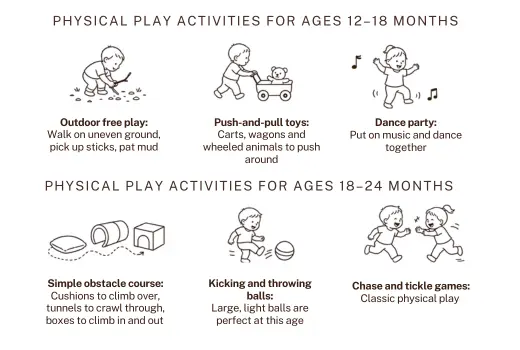
Physical play activities for ages 12-18 months:
- Outdoor free play: Walk on uneven ground, pick up sticks, pat mud. Varied terrain is excellent for balance and proprioception.
- Push-and-pull toys: Carts, wagons and wheeled animals to push around support early walkers and build coordination.
- Dance party: Put on music and dance together. Following your movements builds imitation skills and the movement-language link.
Physical play activities for ages 18-24 months:
- Simple obstacle course: Cushions to climb over, tunnels to crawl through, boxes to climb in and out of. Builds problem-solving and physical skill.
- Kicking and throwing balls: Large, light balls are perfect at this age. Kicking requires balance and coordination; throwing develops spatial awareness.
- Chase and tickle games: Classic physical play that also deepens attachment and teaches toddlers about turn-taking in interaction.
Type #2: Creative play activities
Creative play at this age is entirely about process, not product. A 15-month-old painting with their fingers is not trying to make something beautiful. They are experiencing color, texture, shapes, cause and effect, and the extraordinary power of making a mark on the world.
Fine motor skills developed through creative play, such as gripping crayons, pinching playdough, or using a paintbrush, lay the physical foundations for later writing.
Examples of what parents can play with creative minds:
- Drawing and coloring: Chunky crayons or chalks on large paper. Let them scribble freely. Name colors and shapes as they work without directing the outcome.
- Playdough: The ultimate toddler creative material. Squishing, poking and rolling builds hand strength and fine motor control. Add simple tools e.g a plastic fork, a rolling pin as small kids approach 18 months.
- Finger painting: Messy but extraordinarily rich. The sensory experience of paint on hands activates multiple brain regions simultaneously.
- Simple collage: Tearing paper and sticking it with a glue stick is achievable from around 18 months and deeply satisfying.
- Painting with unusual tools: Sponges, cotton balls, or even feet. Varied textures keep the sensory experience rich and the activity fresh.
💡 Parent tip
The messier the activity, the richer the learning. Set up with an old tablecloth underneath and easy-clean clothes on, then genuinely let go. Your relaxed presence signals that exploration is safe and welcome.

Type #3: Pretend and imaginative play activities for 1–2 year olds
Symbolic thinking or the ability to let one thing stand for another, begins to emerge around 18 months. It is one of the most significant cognitive milestones of early childhood.
When a toddler picks up a banana and holds it to their ear like a phone, they are doing something really impressive: they are using a symbol. This is the cognitive foundation for language, reading, mathematics, and empathy.
Lieberman describes this as ‘discovering how minds work’ — toddlers are beginning to understand that other people have thoughts, feelings, and intentions separate from their own. Imaginative play is how they practice that understanding.
Examples of pretended play activities for little ones:
- Dressing up: Hats, scarves, bags, shoes. Simple dress-up props are more effective than elaborate costumes. The point is trying on roles, not looking the part.
- Role play e.g. shop, doctor, kitchen: Set up a simple ‘shop’ with tins from the cupboard, or a ‘kitchen’ from a cardboard box. At 12–18 months this will be very simple e.g. feeding a toy, putting things ‘to sleep’. By 24 months, narratives become richer.
- Small world play: A tray with toy animals, figures, or vehicles. Toddlers aged 18–24 months begin to create scenarios such as animals ‘eating,’ cars going to ‘sleep.’ Follow their narrative rather than directing it.
- Dolls and soft toys as characters: Caring for a doll or a stuffed toy e.g. feeding it, putting it to bed, comforting it helps toddlers process their own experiences of being cared for.

Type #4: Sensory play activities for little ones
The toddler brain is a sensory-hungry machine. Touch, smell, sound, sight, and proprioception (the sense of where your body is in space) are all actively developing, and each new sensory experience creates and supports neural pathways. Sensory play is not just enjoyable. It is neurologically essential.
Nelsen and her co-authors note that children learn through all their senses, and having the opportunity to get messy is a valuable part of learning.
Examples of sensory play activities for toddlers:
- Sensory bins: A plastic tub filled with rice, dried pasta, sand, or oats with a few scoops and containers. Pouring, filling, and emptying builds fine motor skills and mathematical understanding (more, less, full, empty).
Pro tip: Use child-sized containers and place items on low shelves toddlers can easily reach by themselves. - Water play: A bowl of water with cups, spoons and small toys. Add food colouring for a simple, captivating variation. Supervision always required.
- Nature textures: Gather leaves, pinecones, bark, smooth stones, and grass. Let them touch, smell, and explore each one. Language input here is gold: ‘rough,”smooth,”cold,”soft.’
- Textured treasure basket: A basket of objects with different textures and materials — a wooden spoon, a soft cloth, a rubber ball, a metal spoon. Classic Montessori heuristic play, ideal from 12 months.
Pro tip: Have an important call or meeting coming up? Prepare a basket of toys or objects your child hasn’t played with yet, and give it to them just before the call starts.

Type #5: Social play activities for toddlers 1–2 years
A reasonable question about ‘social activities’ for 1–2-year olds is: aren’t they too young for that? The short answer is no.
Developmental psychologists distinguish between parallel play (playing alongside another child without directly interacting) and cooperative play (playing together with shared goals). Toddlers aged 12–24 months are primarily parallel players. They are deeply interested in what other children are doing; they watch, imitate, and inch closer. But they are not yet ready for genuine turn-taking or shared games. That is entirely normal and itself a valuable learning experience.
Language acquisition accelerates in social contexts. Simply being around other adults and children who speak to and around them provides immense input.
Social play activity examples for little ones:
- Playdate with a peer: Keep it simple: two toddlers, an open space, and some toys each. Manage conflict calmly and without over-intervention. Parallel play is the goal, not interaction.
- Library storytime: Group singing, rhymes, and shared book reading. Excellent for language development and early experience of group participation.
- Playgroup or class: Music, movement, or messy-play classes provide social context, language input, and variety. Look for sessions with free exploration rather than rigid instruction.
- Playing with older siblings: Older children naturally model more complex play that toddlers find compelling. Supervised, this can accelerate language and imaginative play significantly.

Type #6: Quiet and cognitive activities for toddlers 1–2 years
Not every activity needs to be loud and physical. Quiet, focused activities build concentration, early problem-solving, and the capacity to self-regulate — all crucial skills that will serve your child throughout their education and beyond.
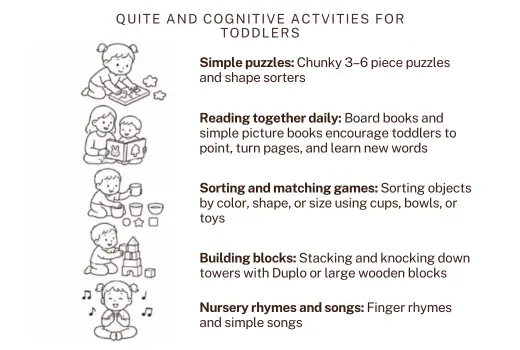
Examples of quite activities for toddlers:
- Simple puzzles: From 15 months, chunky knob puzzles with 3–6 pieces are appropriate. Shape sorters work well from 12 months. Resist the urge to ‘help’ too quickly — the problem-solving process is where the learning happens.
- Reading together daily: Board books at 12 months; simple picture or wordless books by 18–24 months. Let them point, turn pages, and ‘name’ pictures. Read the same books repeatedly
Pro tip: When your kid asks you to read the same book over and over again, it’s totally normal. - Sorting and matching games: Sorting objects by color, shape, or size begins around 18–24 months. Colored cups, nesting bowls, or simply grouping toys by type. Early maths is happening here.
- Building blocks: Stacking and knocking down towers (the knocking down is equally important — cause and effect in action). Duplo or large wooden blocks from 12 months; more intentional building by 24 months.
- Nursery rhymes and songs: Finger rhymes (Incy Wincy Spider, Round and Round the Garden) combine language, memory, rhythm, and physical interaction. Ideal quiet-time activity.
Why every type of play matters and why balance Is non-negotiable
It can be tempting to lean into the activities your toddler loves most or the ones are easiest for you to set up. If your child is a runner, physical play might fill every afternoon. If you love books, quiet reading might dominate. These tendencies are natural, but developmental research is clear: no single type of play can do what all six together can.
Each category develops a distinct set of skills that the others cannot fully replace:
| Play Type | What it builds | What’s missed without it |
| Physical | Gross motor skills, body confidence, sleep quality, emotional regulation through movement | Restlessness, sensory-seeking behaviour, reduced coordination |
| Creative | Fine motor control, self-expression, tolerance for open-ended tasks, early writing readiness | Difficulty with mark-making and later handwriting; reduced creative confidence |
| Pretend / Imaginative | Symbolic thinking, empathy, narrative language, emotional processing | Delays in language complexity and theory of mind development |
| Sensory | Neural pathway formation, sensory tolerance, scientific thinking (cause & effect) | Sensory sensitivity or avoidance; reduced tactile discrimination |
| Social | Language acquisition, turn-taking, reading social cues, conflict navigation | Slower language growth; difficulty in group settings later on |
| Quiet / Cognitive | Concentration, early numeracy and literacy, self-regulation, memory | Shorter attention span; less comfort with stillness and focused tasks |
Think of the six categories as nutrients. Just as a toddler who only eats one food group will develop gaps, a toddler whose play is dominated by one type will develop unevenly, not because of any failing, but simply because the other areas haven’t had the stimulation they need.
That balance doesn’t require a perfectly engineered schedule. A week that includes some outdoor running, some messy creative play, some quiet book-reading, some sensory exploration, some imaginative play,and some social exposure is doing exactly what it needs to do — even if none of those happened on the ‘right’ day, or lasted longer than 20 minutes.

A sample weekly activity plan for toddlers 1–2 years
Every family’s routine is different, so the plan below is a starting point. Not something fixed. Treat this as a template you can adapt to your own week; swap activities freely, shorten or extend sessions to match your toddler’s mood and energy. You can also skip anything that doesn’t feel right or ends up causing stress.
A session can be as short as 15–20 minutes. The goal is simply that, across the week, all six play types appear at least once.
| Day | Morning | Midday / After Lunch | Afternoon | Wind-down |
| Monday | Outdoor free play (Physical) | Sensory bin — rice & scoops (Sensory) | Shape sorter / puzzle (Quiet/Cognitive) | Bedtime stories (Quiet/Cognitive) |
| Tuesday | Finger painting (Creative) | Library storytime (Social) | Small world play — animals (Pretend) | Nursery rhymes & songs (Quiet/Cognitive) |
| Wednesday | Dance party (Physical) | Playdough (Creative) | Water play — cups & pouring (Sensory) | Books on lap (Quiet/Cognitive) |
| Thursday | Playdate / parallel play (Social) | Stacking blocks (Quiet/Cognitive) | Dressing-up box (Pretend) | Songs & finger rhymes (Quiet/Cognitive) |
| Friday | Obstacle course (cushions) (Physical) | Sorting by colour (Quiet/Cognitive) | Nature walk — collect textures (Sensory) | Repeat favourite book (Quiet/Cognitive) |
| Saturday | Park / outdoor exploration (Physical) | Simple collage — tearing & sticking (Creative) | Role play — toy kitchen / shop (Pretend) | Stories with dad/grandparent (Social + Quiet) |
| Sunday | Rough-and-tumble play (Physical) | Sensory: cooking alongside (Sensory) | Puzzle + blocks free play (Quiet/Cognitive) | Quiet books & cuddles (Quiet/Cognitive) |
How to adapt this plan:
- Swap freely.
- Shorten sessions to match your toddler’s attention span — 15 minutes of engaged play beats 45 minutes of wandering.
- Combine types naturally — a nature walk is Physical + Sensory; reading after playdough is Creative + Quiet. Don’t overthink it.
- If a day goes sideways, let it go. One missed category in a week is irrelevant. One missed category every single week, for months, is worth noticing.
- Your toddler’s mood is always the guide. A tired or overwhelmed toddler needs rest and closeness, not an activity.
Learning through play — weekly activity log
One of the most useful tools for parents of toddlers is a simple weekly activity log — a way to track which types of play your child is getting each week, so you can spot any gaps and ensure variety across all six developmental domains.
The principle is simple: a good week of play for a 1–2 year old includes something from each of the six categories. You do not need to tick every box every day. The goal is variety across the week, not a packed daily schedule.
The 6 play categories:
- Physical play: Running, climbing, dancing, outdoor exploration
- Creative play: Drawing, painting, playdough, crafts
- Pretend / imaginative play: Dressing up, role play, small world play
- Sensory play: Textures, water, sand, nature, sound
- Social play: Playdates, groups, alongside siblings or peers
- Quiet / cognitive play: Puzzles, books, sorting, building, songs
We designed the Weekly Activity Log to track your toddler’s play this week. Print it, stick it on the fridge, and tick off activities as they happen. No pressure — it is a guide, not a report card.

A brief note on screen time
The current guidance from the American Academy of Pediatrics (AAP) and the World Health Organization recommends avoiding screen-based media for children under 18–24 months except for video calls. From 18–24 months, if screens are introduced, high-quality programming with an engaged parent watching and explaining alongside is recommended.
Researchers like Lieberman and Nelsen make a similar point. The issue isn’t really that screens are “bad,” but that they take time away from the back-and-forth interaction toddlers need most. A screen can’t react when your child babbles, notice what they’re pointing at, or shift language depending on their level. You can do all of that naturally in everyday interaction.
Most families use screens in some way, and that’s normal. The important thing is what else is happening around it. If a toddler still spends most of their time playing, talking, and interacting with you, a little screen time, e.g. 20 minutes, is usually just one part of the day.
The bottom line
For our little curious minds, learning doesn’t come from structured programs. Joyful, varied, low-pressure play in the company of a warm, responsive adult is the most effective early learning program available.
FAQ
What are the best learning activities for a 1-year-old?
At 12 months, the best activities are simple and sensory. A basket filled with everyday safe objects, such as a wooden spoon, a soft cloth, or a silicone cup, can keep a toddler busy for a long time. Water play, stacking blocks, and being outside also work well. But what matters most isn’t the activity itself—it’s you being there, watching, responding, and joining in.
What is play-based learning for toddlers?
Play-based learning is simply the understanding that play is the main mechanism through which young children learn — not a supplementary activity, but the main event. For toddlers aged 1–2, this means that stacking blocks is maths, pouring water is physics, listening to stories is language development, and chasing a ball is science. No formal instruction is needed or beneficial at this age.
When do toddlers start playing with other children?
True cooperative play — playing together with shared goals and rules — typically develops from around age 3. At 12–24 months, toddlers engage in ‘parallel play’: playing alongside other children, watching them, and imitating them, but not yet playing with them in the cooperative sense. This is developmentally normal and itself valuable. Social exposure at this age is still enormously beneficial for language and social development.
How many activities should a 1-2- year old do per day?
There isn’t a magic number of activities toddlers need each day. What seems to matter more is variety over the week—some movement, some quiet play, some social time, some messy sensory play.
A normal day can be very simple. Toddlers often just explore and repeat the same little “games” on their own. You might join in for a quick book or build something together for a few minutes. That’s enough. Packing the day with activities usually backfires—they get overwhelmed, not enriched.
References & further reading
- Lieberman, A.F. (2017). The Emotional Life of the Toddler (2nd ed.). Simon & Schuster
- Nelsen, J., Erwin, C. & Duffy, R. (2015). Positive Discipline: The First Three Years (3rd ed.)
- World Health Organization (2019). Guidelines on Physical Activity, Sedentary Behaviour and Sleep for Children Under 5 Years of Age. WHO Press