
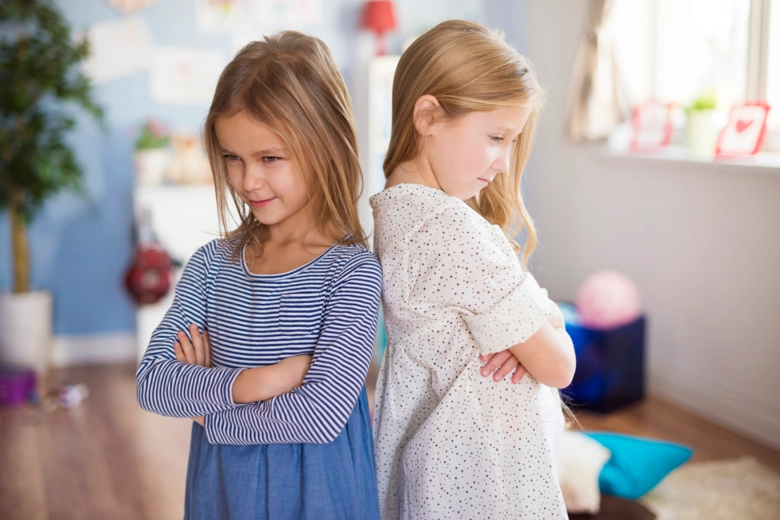
Sibling rivalry is a normal part of growing up and, on its own, rarely means anything is wrong. As children develop, the best way to respond changes too, from preventing and redirecting conflicts with toddlers, to coaching preschoolers through disagreements, to helping older children solve problems together.
Many sibling fights are really expressions of an unmet need or a bid for connection, which is why predictable routines, fair (rather than identical) treatment, and regular one-on-one time are often more effective than constantly stepping in to referee. When approached with warmth and consistency, sibling rivalry can become the foundation for a relationship that lasts a lifetime.
Is sibling rivalry normal?
In the sibling studies discussed by Dr. Laura Markham in Peaceful Parent, Happy Siblings, only about a third of children are described as consistently warm and caring toward one another. Another third fall into the category most families would recognize: affectionate one moment, openly competitive the next.
What matters most, though, is the pattern behind those numbers. The strongest sibling relationships tended to develop in homes where at least one parent was consistently warm, emotionally available, and able to set clear expectations without relying on pressure, criticism, or emotional distance.
Sibling rivalry by developmental stage
Here is the short version of how the right response shifts as children grow:
| Stage | What is happening developmentally | What helps most | What to skip | An everyday example |
| Toddlers (1–3) | Impulse control is immature; little language for big feelings | Prevention, close supervision, redirection, simple words like “Stop” and “My turn” | Negotiation, reasoning, expecting them to “work it out” | A toddler bites when a sibling grabs a toy, and a nearby parent steps in and offers the words “My turn” |
| Preschoolers (3–5) | Perspective-taking begins; turn-taking and fairness start to make sense | Simple conflict coaching, predictable routines, visual schedules, cooling off together | Taking sides, forcing apologies, sending a child off alone | Two preschoolers fight over a toy, and each is coached to say how they feel and suggest a fix |
| School-age and up (5+) | Can reason, negotiate, and hold an agreement | Written agreements, clear family rules, problem-solving they lead themselves | Refereeing every dispute as the family judge | Siblings argue over the tablet, so they draw up a turn schedule and let a timer call time |
Cooperation is a skill children grow into rather than one they are born with, and the right activities help it along at every age. For playful, age-appropriate ideas, see our guide to cooperation activities for kids.
Toddlers (1 to 3 years): big feelings, little impulse control
When toddlers fight, they’re acting on impulse, not strategy, and almost never out of cruelty. The part of the brain responsible for self-control and impulse regulation is still years away from maturing, so powerful emotions routinely overwhelm what toddlers may already know about hitting or hurting others.
Add in limited language skills, and frustration has very few ways out. Grabbing, hitting, biting, and scratching are the predictable result of that combination.
At this age, prevention matters far more than correction. Close supervision and timely intervention do most of the work. Sitting nearby, ready to step in before emotions escalate, prevents far more conflict than any conversation after the fact. When a toddler does lash out, the goal is to intervene calmly, set a clear and simple limit, and redirect them toward a more appropriate way of expressing what they need.
💡 A parent’s story
The problem: With two little ones close in age, the same flashpoints kept repeating: a bite, a hit, a kick, or a toy snatched straight out of the other’s hands.
What helped: One calm, consistent response carried the day. Every time someone got hurt, the aggressor was gently moved away with a simple “Ouch, that hurts.” Every time a toy was grabbed, it went back to whoever had held it first. No lectures and no bargaining, just the same limit every single time. The consistency did the teaching, because a toddler learns a rule by meeting it the same way again and again.
As Markham explains, toddler aggression almost always has an understandable cause beneath the behavior.
- Wanting to connect. Sometimes a toddler hits an older sibling because they’re trying, awkwardly, to get their attention or invite them to play. Instead of focusing only on the hitting, give them the words they don’t yet have: “You want to play. You can say, ‘Play with me.'”
- Wanting the toy. A toddler who grabs often isn’t being selfish so much as lacking the language and self-control to ask. Repeatedly model simple phrases like “Can I have a turn?” or “Can we trade?”.
- Retaliating. Sometimes the toddler is hitting back after being teased or having a toy taken away. Help them put words to what they’re feeling: “You’re angry because your toy was taken.”
- Running on empty. Hunger, exhaustion, or sensory overload can quickly spill over into aggression toward a sibling. In these moments, meeting the underlying need, whether that’s food, rest, or a few minutes of calm, connected attention, is far more effective than trying to reason with the child.
- Feeling jealous. A toddler may lash out because they want the attention a parent is giving an older sibling. Even a brief moment of focused attention can help ease the insecurity that’s fueling the behavior.
The most useful thing a parent can teach a toddler at this stage is a handful of short, powerful phrases to use instead of hands: a clear “Stop,” a “My turn,” a “Move, please.” Making a game of those words, well before a conflict erupts, gives a small child a tool they can actually reach for in the heat of the moment.
Preschoolers (3 to 5 years): learning to see the other side
During the preschool years, children develop an important new skill: the ability to begin seeing the world from someone else’s perspective. A four-year-old is starting to understand that a sibling has thoughts and feelings that are separate from their own, even when those feelings conflict with what they want.
At this age, conflict becomes an opportunity to coach rather than simply intervene. Here is the sequence Dr. Laura Markham recommends:
- Step in to stop any physical aggression.
- Resist the urge to decide who was right and who was wrong, even when one child’s behavior seems more obvious.
- Let everyone calm down first, often by spending a few quiet minutes together rather than being sent away alone.
- Give each child a chance to describe what happened while the parent listens and reflects back what they hear.
Only after everyone feels heard does problem-solving begin:
- Restate the family rule simply: “We don’t hit.”
- Encourage the children to tell each other how they feel and what they need, using language about their own emotions instead of blaming or criticizing the other person.
The goal isn’t to extract an apology or determine a winner. It’s to help the children repair the relationship by coming up with their own idea for making things better.
Preschoolers also thrive on predictability. Daily routines they can rely on, simple visual schedules, and a small number of clear, consistent family rules all help reduce the uncertainty that often fuels sibling conflict.
Preschoolers and older children (3+): when the fighting turns verbal
Roughly from age three onward, the nature of sibling conflict changes. Language is no longer the limiting factor, and children are beginning to reason, negotiate, and argue. As a result, conflict shifts away from physical outbursts and into words. Grabbing and biting gradually give way to teasing, name-calling, tattling, and endless debates over who had more, who got there first, or whose turn it really is.
Children at this age are also capable of genuine competition. They compare themselves to their siblings, compete for a parent’s attention and approval, and become increasingly aware of who seems to have more freedom or better treatment.
Fairness quickly becomes the lens through which they judge almost everything, which often tempts parents to make everything exactly equal. Markham argues that a better goal is fairness rather than sameness. Children are generally willing to accept different treatment when they understand why it is fair:
- A longer turn goes to the child who waited patiently.
- Greater privileges come with greater responsibilities.
- A later bedtime reflects an older child’s age and duties, not favoritism.
Perhaps the biggest developmental change is that children are finally able to take part in solving their own disagreements. At this age they can:
- practice taking turns,
- talk through simple problems, and
- stick to agreements they helped create.
Instead of deciding who wins every argument, parents can describe the problem, remind the children of the family rule, and guide them toward finding a solution together.
Practical tools, like visual schedules, kitchen timers, or simple agreements the children help design, often work surprisingly well.
Long car rides are their own special arena, where a shared back seat, limited space, and nowhere to escape can turn small irritations into full battles. A sibling car agreement gives children a say in setting fair rules for the ride, encourages kindness, and helps keep everyone safe, turning backseat chaos into a conversation that can flex as they grow.
Screens, devices, and gaming: the modern flashpoint
Arguments about screen-time limits, who controls the shared tablet, whose turn it is on the console, and what counts as “fair” access to a family device are among the most reliable sources of sibling conflict in homes with children a few years apart.
The encouraging part is that the same principles that help with other sibling conflicts work here too. Markham’s approach is to take the parent out of the impossible role of constant judge. A simple example is the classic rule: one child divides, the other chooses.
For example, a parent might hand the decision back with a line like, “One of you splits the tablet time into two turns, and the other picks which turn to take first,” or “You set the timer for each turn, and your sister chooses who goes first.”
The parent no longer has to decide who got more. With older children, that idea can be expanded into written agreements the siblings help create themselves, and those agreements often carry surprising weight, even for children who can’t yet read.
💡 A parent’s story
The problem: A seven-year-old and a four-year-old shared a single tablet, and every afternoon ended the same way. The older child insisted the younger one had already had a long turn. The younger child screamed the moment the tablet was taken away. A parent was repeatedly pulled in to decide whose turn it was, with the same argument happening day after day and nothing ever sticking.
What helped: The parent stepped out of the referee’s chair. With a little guidance, the children created their own turn schedule using pictures the four-year-old could understand, a sun for the older child’s turns and a moon for the younger child’s. A kitchen timer signaled when each turn ended. Because the children had helped create the rule, and because the timer, not the parent, was the thing ending the turn, the daily fight shifted away from the parent and onto a system both children had agreed to.
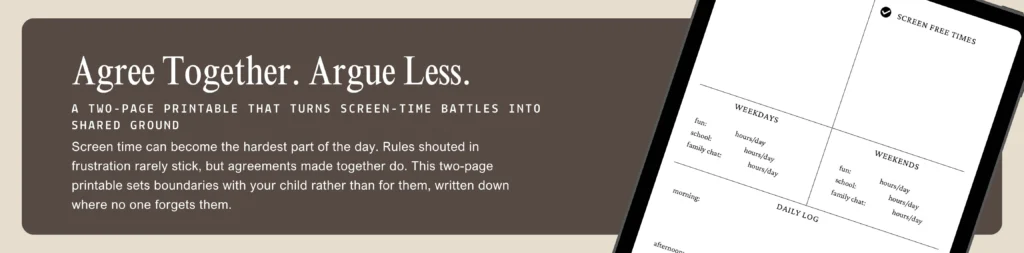
A simple written “family tech agreement” about who gets the device on which days, or how turns are measured, resolves far more arguments than case-by-case rulings ever do.
Our Parent-Child Technology Agreement is a ready-made version of this idea: a short, printable agreement that puts the expectations in writing so the rule remains clear long after the conversation is over.
When the usual advice for sibling rivalry does not fit: special situations
Much of the advice about sibling rivalry assumes a fairly typical family structure: two biological siblings, close in age, with similar temperaments, growing up under the same household rules. Many families don’t fit that picture, and when they don’t, sibling conflict often looks different.
Blended families: loyalty, rules, and time
In a blended family, arguments are rarely just about toys, turns, or whose bedtime comes first. The blended family statistics show how many children are now growing up in these homes, and many are navigating complicated feelings of loyalty. Warming to a new step-sibling can feel, however irrationally, like a betrayal of an absent parent or of the family life they once knew.
Children also bring different expectations into the home. Each may have grown up with different routines, rules, and parenting styles. What looks like sibling rivalry is often the strain of two family cultures trying to become one.
That means the work is usually slower and more gradual than it is in families who have always lived together.
💡 A parent’s story
The problem: Two children, one from each parent, suddenly found themselves sharing a home and were expected to act like siblings. The eight-year-old became distant and territorial, insisting that her new stepbrother wasn’t really her brother and didn’t have to follow “her mom’s rules”.
What helped: The turning point came when the adults slowed the process down and recognized the loyalty conflict beneath the behavior. Each child continued to have regular one-on-one time with their biological parent, so growing closer to a new sibling never felt like replacing someone else. At the same time, the adults agreed on a small set of household rules that applied equally to everyone, removing the recurring argument over whose parent’s rules mattered.
Rather than forcing closeness, the family focused on low-pressure opportunities to spend time together. Shared games, meals, and everyday activities gradually built familiarity and trust. The relationship didn’t change overnight, but over the course of months, the tension eased and genuine connection had room to develop.
Step-siblings: the challenge of forced closeness
Step-siblings face a unique version of sibling rivalry: forced closeness. They didn’t choose each other, may have little in common, and are often expected to feel like family on a timeline that few relationships naturally follow. That pressure to bond usually has the opposite effect. Children are far more likely to grow closer through shared positive experiences that happen without an agenda or expectation.
Early on, the goal doesn’t have to be affection. Mutual respect, a sense of safety, and a handful of genuinely enjoyable shared experiences are enough. Real closeness is much more likely to develop when it’s allowed to grow at its own pace rather than being demanded.
Twins and multiples: living with constant comparison
Twins and other multiples face a very different challenge: constant comparison and an unusually intertwined sense of identity. Because they are the same age and experience every developmental stage together, it’s easy for adults, and for the children themselves, to compare them.
Over time, they may begin to see each other less as siblings and more as direct competitors in a way that children with larger age gaps often do not.
💡 A parent’s story
The problem: Four-year-old twins were compared constantly by relatives, teachers, and even by each other. One had become “the talkative one” while the other was known as “the shy one”. Those labels gradually hardened into identities, and the rivalry grew as each child tried to carve out a place that belonged only to them.
What helped: The parents made a deliberate effort to remove opportunities for comparison wherever they could. They stopped referring to “the twins”, used each child’s name instead, and created regular one-on-one outings so each child had experiences that belonged only to them. They also asked relatives to avoid side-by-side comparisons and labels.
Markham argues that protecting each child’s individuality is especially important for twins and other multiples. A few small changes help loosen the grip of competition:
- Use each child’s name instead of treating them as a single unit.
- Avoid side-by-side comparisons.
- Make space for separate interests and friendships.
- Protect regular one-on-one time with each child as a genuine developmental need.
When children are given room to become distinct individuals, they have less need to compete for an identity of their own.
Temperament mismatch: clashing by nature
Some siblings simply have clashing temperaments, and the research Markham cites treats this as a real challenge rather than something children should simply “grow out of”. A quiet, highly sensitive child who is easily overwhelmed by noise and activity may find daily life with an energetic, constantly moving sibling genuinely exhausting. The opposite pairing has its own challenges, too. Strong-willed and emotionally intense children are more likely to experience and generate sibling conflict, particularly in the early years.
The encouraging news is that temperament doesn’t determine the quality of the sibling relationship. One of the strongest protective factors is the parent’s relationship with the child who is more challenging to parent.
💡 A parent’s story
The problem: A quiet, easily overwhelmed six-year-old shared a home with a loud, endlessly energetic three-year-old. The older child constantly sought quiet and space, while the younger one inevitably followed, interrupting every attempt to be alone. Most afternoons ended with shouting, pushing, and tears.
What helped: Instead of trying to make the children behave as though their temperaments matched, the parents accepted the differences and adapted their routines accordingly. The older child was given a dedicated quiet space that the younger sibling learned to respect, along with a simple signal she could use when she needed time alone.
At the same time, the parents invested extra warmth and connection in their relationship with the younger, more emotionally intense child.
Preventing sibling rivalry through the environment
Much of what looks like a sibling rivalry problem is really an environment problem. This is where a Montessori-informed perspective is especially valuable. A thoughtfully prepared environment can prevent many conflicts before they ever begin.
- Clear ownership of belongings. Children who know which items belong to them, and have a designated place to keep them, have fewer reasons to defend their territory.
- Personal space. Even a small corner that reliably belongs to one child gives an overstimulated sibling somewhere to retreat instead of reacting.
- Predictable routines and visual schedules. Knowing what comes next reduces the uncertainty and anxiety that often fuel conflict.
- Thoughtful resource management. Having enough of commonly shared items, or a clear and consistent system for sharing those that are limited, removes many of the most common flashpoints.
- Less built-in competition. Preventing conflict is almost always easier than trying to resolve it once it has begun.

Many sibling conflicts are signs of an underlying need rather than the real problem itself. Before focusing on correcting a child’s behavior, pause to consider what they might be trying to communicate. A useful reminder is the HALT framework:
- Hungry
- Angry
- Lonely
- Tired
This aligns closely with Markham’s emphasis on prevention rather than reaction. A toddler who throws a cup or scratches a sibling after a long afternoon is often communicating an unmet need rather than deliberately misbehaving. Once that need is addressed, the behavior itself frequently fades.
Markham describes this approach as a form of preventive maintenance: regularly replenishing each child’s emotional reserves so the family doesn’t move from one crisis to the next. Several simple habits consistently strengthen sibling relationships:
- Predictable routines help children feel secure enough to regulate their emotions.
- Leading with empathy allows children to feel understood before parents try to teach, correct, or solve the problem.
- Daily roughhousing and playful physical connection create laughter, release built-up tension, and strengthen relationships.
- One-on-one Special Time is perhaps the most powerful tool of all.
Special Time is a short, daily period of completely child-led attention, even ten minutes is enough. During that time, the parent follows the child’s lead instead of directing or teaching. Families who practice it consistently often find that aggression, tantrums, and sibling conflict decrease more quickly than they expected. The reason is simple: many sibling fights are really bids for connection. When children receive that connection intentionally every day, they no longer have to compete for it through conflict.
Building the sibling relationship, not just managing the conflict
It’s easy to think of sibling rivalry as something that simply needs to be managed. But building a strong sibling relationship is just as important as resolving disagreements. That bond grows little by little through shared positive experiences, family traditions children look forward to, and everyday moments that help them feel like they’re on the same team.
One simple way to strengthen the sibling bond is to create opportunities for children to work together. For example, put the siblings on the same team against a parent in a game or a playful challenge they can only win by cooperating.
Afterward, take a moment to name what they did well, whether they solved a problem together, encouraged each other, or refused to give up. A few words are enough. A parent might say: “I loved watching you two work together. Did you notice how you helped each other? When you teamed up, you solved it much faster.” or “You made a great team. You helped each other and kept going, and working together like that makes hard things easier.”
💡 A parent’s story
The problem: Two siblings who seemed to argue constantly had almost no positive shared experiences left. Nearly every interaction ended in conflict, and their parents realized they were spending all their energy breaking up fights instead of helping the relationship grow.
What helped: The parents began creating positive experiences intentionally. They teamed the children up against an adult during family games and made a point of noticing their cooperation out loud. When the siblings were happily absorbed in playing together, the parents protected that time instead of interrupting it. They also introduced a weekly “sibling adventure”, a simple outing or activity the children shared with one parent, giving them new memories to enjoy together.
In everyday family life, sibling closeness is often built through a handful of simple, consistent habits:
- Habit #1: Protect successful play. When siblings are happily playing together, let them enjoy it without interruption whenever possible.
- Habit #2: Create opportunities for joyful connection. Outdoor adventures, dancing, singing, roughhousing, building forts, and imaginative play naturally create the laughter and closeness that strengthen relationships.
- Habit #3: Set aside regular sibling time without screens. Even a short period of shared play helps make connection part of the family’s routine, especially when siblings have large age gaps or different interests.
- Habit #4: Keep each child’s emotional cup full. One-on-one time, small acts of affection, and moments of undivided attention help ensure no child feels they must compete for a parent’s love.
One finding offers particular reassurance for parents: siblings can be very close and still argue often. In fact, research shows that children who are close in age tend to have more frequent disagreements than siblings with larger age gaps, yet they also tend to share especially close emotional bonds.

Researcher Judy Dunn has even suggested that some of this everyday arguing helps children develop the skills they need to play, negotiate, and cooperate with each other. In a family where children feel secure and conflicts are handled constructively, plenty of bickering can exist alongside genuine affection. The goal isn’t a perfectly quiet home. It’s a home where children know how to repair, reconnect, and keep choosing each other, even after they’ve argued.
What the psychological research says about sibling rivalry
The effort is worthwhile because the sibling relationship is often the longest relationship a person will have. The patterns established in childhood don’t disappear when children grow up. Siblings who build a close relationship early in life often become lifelong sources of comfort because they are the only people who truly share the experience of growing up in the same family. Research links those warm sibling bonds to better mental wellbeing and stronger relationships in adulthood.
There’s another reason this relationship matters so much. For most children, siblings provide the first opportunity to practice resolving conflicts with someone who is an equal rather than an authority figure. They learn to negotiate, compromise, repair after disagreements, and stay connected even when emotions run high. Those experiences become the foundation for many of the relationships that follow.
The research points to one factor above all others: a parent who is consistently warm, emotionally available, and willing to coach rather than control. That steady presence doesn’t eliminate sibling rivalry, but it gives children the security they need to move through it and build a relationship that can last a lifetime.
A note: This article is intended for general educational purposes. Every child, sibling relationship, and family is different. If sibling conflict is persistent, unusually aggressive, or causing significant distress, it’s worth discussing your concerns with a pediatrician or a qualified child psychologist.
This article draws on the research and frameworks presented in Dr. Laura Markham’s Peaceful Parent, Happy Siblings: How to Stop the Fighting and Raise Friends for Life (Perigee, 2015).