
Figuring out how to find a good preschool or nursery is one of those parenting decisions that can feel surprisingly high-stakes. You want a place where your child feels safe, seen, and genuinely happy — not just somewhere with a cute logo and a waiting list.
TL;DR Experts agree: in-person visits are the gold standard for choosing preschools. Observe teacher-child interactions closely and ask detailed questions — what you see and hear will matter most.
When should you start looking for a preschool (nursery)?
The honest answer: earlier than you think. Knowing how and when preschools accept applications puts you ahead of most parents. In many areas, popular programs fill up fast, sometimes more than a year in advance. If you’re hoping for a September start, aim to begin your search the previous autumn or winter at the latest.
Don’t panic if you’re starting later than that. Spots do open up due to cancellations, and smaller or newer programs often have more availability. Here’s a rough timeline to work from:
- 12–18 months before your desired start date: Begin researching types of schools and identifying local options.
- 9–12 months out: Book tours at your shortlisted schools.
- 6–9 months out: Submit applications and get onto waiting lists.
If your child has additional needs or you’re looking for a specialist or inclusive setting, it can be worth starting even earlier, as availability may be more limited.
Which type of preschool (nursery) should you choose for your child?
Not all preschools are built the same — and that’s a good thing.
- Play-based programs prioritize learning through exploration, imagination, and child-led activity. Children move between activity areas, build social skills naturally — cooperation activities are a great way to support this — and develop curiosity without formal instruction.
- Montessori classrooms are carefully prepared environments where children choose their own activities from a structured set of materials. The focus is on independence, concentration, and following the child’s natural development. Mixed-age groups are common.
- Reggio Emilia-inspired programs treat children as capable, curious individuals with their own theories and ideas. Projects emerge from children’s interests, and documentation of learning (through photos, art, and reflection) is central. Environments tend to be beautiful, thoughtfully designed spaces.
- Waldorf (Steiner) nurseries emphasize rhythm, nature, imaginative play, and a gentle approach to early childhood. Screens are absent, natural materials dominate, and the focus is on the whole child — emotional, creative, and physical — rather than academic skills.
- Academic-focused programs introduce more formal learning earlier, including letters, numbers, and structured lessons. These can work well for some children.
What makes a good preschool?
When parents ask what actually makes a good preschool, the answer isn’t a long list of facilities or a glossy prospectus.
- Warm, consistent relationships: children thrive when they feel securely attached to their caregivers. Low staff turnover, consistent key workers, and caregivers who genuinely know your child’s name, personality, and preferences matter enormously.
- Positive, respectful interactions. Watch how staff speak to children — not just what they say, but how they say it. Teachers who get down to eye level, engage in real back-and-forth conversation, and respond to children’s cues with warmth are doing something genuinely important.
- Appropriate child-to-staff ratios. Lower ratios mean more individual attention, better supervision, and less overwhelmed staff. Check what the ratios are, and whether they’re maintained consistently throughout the day, including during transitions, outdoor play, and nap times.
- A thoughtful learning environment. Good preschools offer a balance of structured and free-choice activities.
- Transparent, supportive communication. A good preschool keeps parents in the loop with regular updates, easy access to staff, and an open-door culture. Incidents are reported promptly and honestly, not brushed under the carpet.
What questions should parents ask during a preschool tour?
Visiting in person is the single best thing parents can do when selecting the best preschools (nursery) for their kid. Use the kindergarten tour to ask real questions — not just the ones on the script. How staff respond to your questions often tells you as much as the answers themselves.
About staffing and continuity:
- What’s the staff turnover rate? Have the same teachers been here for a few years?
- What happens if a staff member is absent ? How are ratios covered?
About approach and philosophy:
- How do you handle conflict between kids?
- What does a typical day look like? Can I see a sample schedule?
- How do you support children who take longer to settle in?
About behavior and discipline:
- Can you walk me through kindergarten’s written discipline policy?
- How do you support a child who is struggling emotionally or having a hard day?
- Do you use any public behavior charts or reward/consequence systems?
About communication and transparency:
- How do you keep parents updated about their child’s day and progress?
- How are incidents and accidents reported to parents?
- What’s the best way to raise a concern if something comes up?
What are the signs of a good preschool?
Beyond the paperwork and the policies, there are things you’ll simply sense when you walk into a good setting. Trust those observations — they’re data, too.
- The children look settled and engaged. Not silent or regimented — genuinely absorbed in what they’re doing, moving freely, laughing, working things out.
- Staff seem calm and present. They’re not huddled in a corner chatting — they’re on the floor with children, narrating, responding, and genuinely engaged.
- There’s a warm atmosphere. It’s hard to define, but easy to feel. Is this a place that feels calm and inviting, or rushed and frazzled?
- Children’s work is visible and celebrated. Artwork and creations hung at child height, not just for show, but at a level children can actually see and take pride in.
- Staff answer your questions openly. Confident, transparent answers. Not defensiveness, vagueness, or a sense that you’re being managed.
- Licenses and accreditations are clearly displayed. A well-run program has nothing to hide.
What are red flags when visiting a preschool (nursery)?
Some things are worth walking away from, even if the preschool location is perfect or the fees seem reasonable. Here are the warning signs that shouldn’t be dismissed:
- High staff turnover. If faces are constantly changing, it’s almost impossible for children to form the stable attachments they need at this age. Research backs this up: developmental psychologist Carollee Howes found that children with secure attachment to their day care teachers were more gregarious and more likely to engage in pretend play with peers, while those with insecure teacher attachment showed higher rates of hostility, aggression, and withdrawal from peers. The consistency and warmth of preschool staff isn’t just a nice-to-have. It’s a building block for how children learn to make and keep friends.
- Children frequently unattended or unsupervised. Any gaps in supervision at preschool age are a safety concern, and a reflection of how stretched the team is.
- Defensive answers to reasonable questions. A well-run setting welcomes parental scrutiny. If your questions are met with irritation or deflection, that’s telling.
- No written policies. If they can’t point you to a written discipline, safeguarding, or complaints policy, that’s a problem.
- Yelling, shaming, or harsh language toward children. This one is non-negotiable. These approaches are harmful, full stop.
- A “trust us” culture. Good settings are transparent. If you get the sense that questions aren’t welcome, that’s a warning sign worth heeding.
- High child distress with no adult response. It’s normal for some upset during settling. But distress that goes unacknowledged, or children consistently left to cry it out alone, is a concern.
The preschool tour checklist that takes the guesswork out
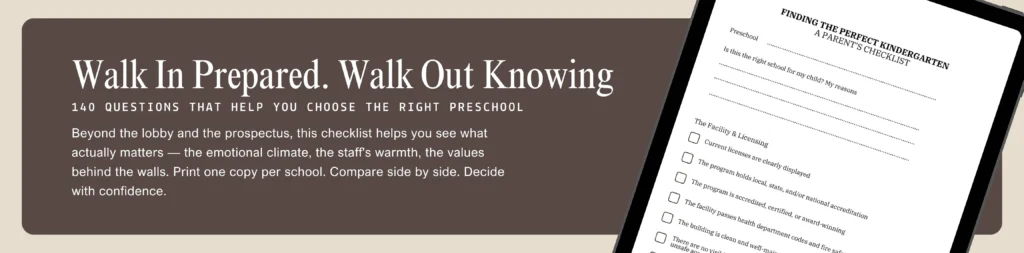
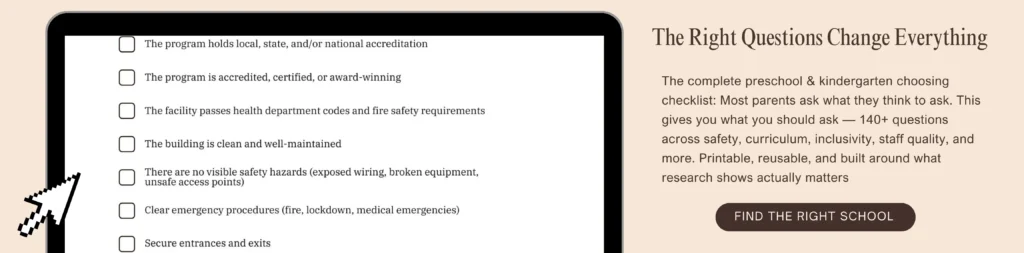
When you’re visiting multiple settings, it helps to have a consistent framework so you’re comparing like with like. Here’s a quick checklist to run through during and after each visit in the pre school or nursery.
The facility
- Current licenses displayed
- Clean, well-maintained environment with no visible safety hazards
- Secure entry and exit points
- Engaging, colorful, child-friendly classroom layout
The staff
- Staff appear calm, patient, and engaged with children
- Teachers get down to children’s eye level
- Staff respond promptly to distressed children
Learning & routine
- Balance of structured and free-choice activities
- Daily outdoor play included
- Open-ended materials prioritized over worksheets
- Predictable, structured daily routine
Your gut check
- Did I feel welcomed when I arrived?
- Did I observe at least one warm, real interaction between a teacher and a child?
- Would I feel comfortable leaving my child here?
- Does my gut feeling feel positive?
How to choose the right preschool for your child?
You’ve done the tours, asked the questions, and made detailed notes. Now comes the harder part: actually deciding. Here’s how to approach it without second-guessing yourself into a spiral.
Tip #1: Start with your non-negotiables. These are the things that genuinely aren’t up for debate — maybe it’s proximity and logistics, an inclusive environment for your child’s specific needs, or a particular pedagogical approach. Once those are accounted for, everything else becomes preference rather than necessity.
Tip #2: Think about your specific child. A highly sensitive child might need a calmer, more intimate environment. An energetic, social child might thrive in a busier setting. A child who’s already reading might need more stimulation than a purely play-based nursery offers. There’s no objectively best preschool — only the best one for this child, at this stage.
Tip #3: Weight the staff over the setting. A modest building with warm, experienced, consistent staff will serve your child better than a stunning facility with a revolving door of exhausted caregivers. Every time.
Tip #4: Talk to other parents. Reviews and word-of-mouth aren’t everything, but lived experience from families who’ve had their children there is genuinely useful. Ask what they wish they’d known before enrolling.
Tip #5: Trust your instincts. No checklist fully captures the feeling of walking into a place and knowing, somehow, that it’s right — or wrong. That instinct is built on real observation. Don’t dismiss it.
When our children were small, choosing the right preschool felt like one of the biggest decisions we’d made as parents. We started researching a full year ahead — asking friends, neighbors, and parents of older children for their honest recommendations. We wanted to know the details that don’t appear on any website: why they chose their school, whether their child had settled in happily, what they loved about it and what they’d change. We visited several times too, meeting the head teacher, exploring the outdoor space, attending open days, and taking every chance we could to talk to the people who’d be caring for our child every day.
Your toddler’s first weeks at preschool will go better with a little preparation. Start here: How to Help Your Toddler Transition to Preschool Without the Tears
What actually matters
The perfect preschool doesn’t exist — but the right one for your child does. It may not have the most impressive facilities or the longest waiting list. It might be smaller, newer, or closer than you expected. What it will have is warm, consistent people who genuinely care, a safe environment where children are free to explore, and a culture that welcomes you as a parent. Focus on those things, and you won’t go far wrong.
FAQ
How many preschools should parents visit to find the best one?
Most parents feel reasonably confident after visiting three to five settings — enough to compare meaningfully without becoming overwhelmed. If you have strong preferences or specific needs (an inclusive setting, a Montessori approach, a particular location), you might visit fewer.
If you’re open to different styles and have several good options nearby, visiting four or five gives a useful reference point. There’s no magic number, but try to see more than one kindergarten — it’s hard to select a place in isolation.
Is academic preschool better than play-based preschool?
Research consistently shows that high-quality play-based learning supports children’s development just as effectively as academic-focused programs — and often better, especially for longer-term outcomes. (Do academic preschools yield stronger benefits? Cognitive emphasis, dosage, and early learning, 2017, pp. 1-11) A well-designed play-based preschool isn’t just children wandering freely; it involves intentional teaching through exploration, social interaction, problem-solving, and language-rich experiences.
Children vary — a child who’s already interested in letters and numbers may need more cognitive stimulation than a purely free-play environment provides. The best approach tends to follow your child’s interests rather than a fixed academic timeline.
What should I do if all my preferred preschools have long waiting lists or are full?
Take a breath. Then get strategic. Contact each school directly and ask where you stand — vague waiting lists are sometimes shorter than they appear. Ask whether a mid-year start is possible. Look at settings you haven’t visited yet. And remember: the preschool your child attends is one part of their early years. The parent they come home to every day is another — and that part is already sorted.