
The toddler to preschool transition is one of the first major emotional milestones in a child’s life — and in yours. Your little one is learning how to feel safe in a bigger world, and you are learning how to let them explore it.
This guide will help parents understand why this transition feels so intense and give practical ways to prepare both your child and yourself.
TL;DR The transition involves emotional, social, and brain development changes. Emotional co-regulation from parents is key. Preparation and predictable routines ease adjustment.
What is the transition period?
A transition period happens when your child moves through something new or experiences a shift in their everyday rhythm. This might mean starting preschool, welcoming a new sibling, moving to a different home, or adjusting to parents separating.
These moments ask your little one to adapt to unfamiliar territory while their sense of safety is still taking shape.
Your little one will encounter different caregivers, navigate unfamiliar schedules, and learn what’s expected of them in this new space. They’ll practice more independence while spending time away from you — the person who has been their anchor.
For a young child, this isn’t a small shift. It’s a full nervous system recalibration, like switching from a quiet room to a bustling marketplace while still learning the language.
Attachment theory and why it matters
Young children are biologically wired to stay close to their caregivers for safety. A secure attachment means your child trusts a fundamental truth: “My caregiver leaves — and comes back.”
Children use their parents as a safe base to explore the world. Preschool challenges this system temporarily. Suddenly, you leave, a new adult becomes responsible, and the environment is unfamiliar. That’s why separation anxiety is not a sign of weakness — it is biologically normal.
Here’s the key truth: strong attachment does not prevent tears. It supports recovery and adaptation. A securely attached child learns something powerful over time: “Even when I feel scared, I am still safe.”
Emotional co-regulation during the transition period
Toddlers cannot fully regulate emotions on their own yet. Their brain’s regulatory systems are still developing, like a car with only first gear and fifth — no smooth transitions in between.
They rely on co-regulation — the adult helps the child manage overwhelming emotions. A calm parent regulates their own nervous system, which in turn helps regulate their preschooler’s nervous system.
Emotional state during drop-off matters more than most parents realize. Children absorb parental anxiety like a sponge. They also absorb calm the same way.
Toddler daycare transition tips
Preparation makes a real difference. Young children don’t yet understand abstract time. Tell a toddler “next Monday” or “in a week,” and it might as well be never or forever. Research shows that preparation reduces anxiety and helps children adjust more smoothly.
Step #1: Create a visual countdown
Create a row of seven or fourteen squares, each one showing a simple image like a school bus or teddy bear. For small kids, time stops being mysterious when it has a shape they can see.
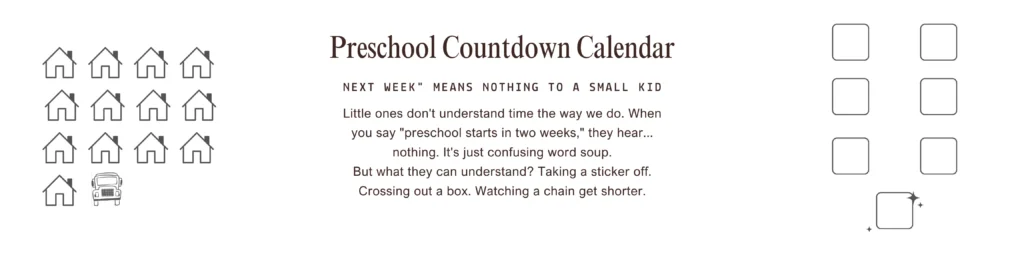
Replace “When?” with “Look, We’re Here!” A countdown calendar that turns constant questions into confident understanding:
Step #2: Talk about what’s coming
Choose a calm moment each day to explain what will change — and reassure your child that your love stays the same. Describe what will be new:
- New routines
- New friends and teachers to meet
- Exciting toys to discover
- Fun activities to try
Don’t rush through it. If your toddler has questions, answer them. If they ask the same question five times, answer it five times. Reassure them with the truth they need most: “We will always come back to take you home.”
Some children, especially quieter or more introverted ones, process slowly. They might not ask anything for days, then suddenly have questions at bedtime or during breakfast. That’s completely normal. When they’re ready, answer with specifics and patience.
Ask if they’d like to bring a comfort object — a small stuffed animal, a favorite blanket, a photo of the family. These anchors can make the unfamiliar feel safer.
Step #3: Count down together
Each e,g, evening, cross out one symbol on your visual chart. When only one box remains, your child will understand: tomorrow is preschool day.
Step #4: Visit and create familiar anchors
Visit the preschool together if possible, or at least walk around the neighborhood nearby. Point out what your child will see on their way each morning — these become anchors that make the route feel safe and known:
- Bus stops with people waiting
- Adults walking to work with their coffee cups
- Runners circling the park
- Green fields dotted with yellow flowers in summer, or trees turning orange and red in autumn
- The corner store with the blue awning
- The crossing guard who waves at children
Quieter or more hesitant children especially benefit from this kind of detailed preparation. When the route feels familiar, the destination feels less overwhelming.
Step #5: Ask gently after preschool begins
After preschool begins, ask gentle questions — without pressure. Quieter children often need time to decompress first. A snack, a quiet car ride, or just sitting together might come before they’re ready to talk.
If your child gives one-word answers, that’s completely okay. “Yes” and “no” are still communication. Parents can gently prompt by describing what they imagine: “I wonder if you played in the sandbox today” or “Did you hear any new songs at circle time?” or:
- “I had a meeting this morning. What did you do first when you got to preschool?”
- Instead of “How was your day?” ask specific, low-pressure questions: “Who did you sit next to at lunch?” or “What color paint did you see today?”
- by describing possibilities: “I’m curious if you played with blocks or if you went outside today”
- with observations: “You have paint on your sleeve — what were you making?
Some children will burst through the door with stories. Others will stay quiet for hours, then mention something small at bedtime. Both are normal.
How can I use books, games, and activities at home to get my toddler excited about starting preschool?
Getting your little one excited about preschool doesn’t require expensive toys or elaborate setups. Simple, playful activities at home can transform the unknown into something familiar and even fun.
Role-play games
Set up a pretend classroom with stuffed animals as classmates. Let your child be the teacher, then switch roles. Practice hanging up a backpack, sitting in a circle, or washing hands before snack time. These small rehearsals make the real routines feel less foreign.
Storytelling with books or personal experience
Read books about starting preschool together — stories where characters feel nervous, then discover they enjoy their new adventure. Share your own memories: “When I was little and started school, I was worried about…” This shows them that feeling uncertain is normal and temporary.
Pretend school play
Create a mini school corner at home with a small table, crayons, and paper. Practice “circle time” where everyone sits and listens. Sing songs, read a story, then have snack time. The rhythm of these activities becomes a preview they can recognize later.
If you want to make the most of this window before preschool begins, here’s a breakdown of all six learning activities for toddlers aged 1–2 that directly support preschool readiness.
Visual storytelling with your own board
Make a simple visual story board using your own drawings or printed images. Include pictures of the preschool building, parks you’ll pass on the way, smiling teachers (even stick figures work), children playing, cubbies with backpacks. Walk through this story together: “First we drive past the park, then we see the blue preschool door, then you hang up your coat…”
Your child can help create it — they might want to draw themselves or add stickers. When they help build the story, they become part of it.
Build predictable routines that make preschool transitions smoother
Young children thrive when they know what’s coming next. Here’s how to build that sense of security into daily life:
- Practice the morning schedule: A week before preschool starts, run through the morning routine at the actual pace it will happen. Wake up at preschool time, get dressed, eat breakfast, brush teeth, pack the backpack. This rehearsal turns the rushed morning from chaos into something your child has already done before.
- Adjust sleep times gradually: If preschool means earlier wake-ups, start shifting bedtime by 15 minutes every few nights.
- Create a consistent bedtime routine: Establish a calming sequence that happens the same way every night: bath, pajamas, story, song, lights out. When everything else feels new and uncertain, this predictable anchor at the end of each day becomes a touchstone. Your child knows what comes next, and that knowing settles their nervous system.
Predictability builds emotional safety. When a toddler can anticipate what happens next, the world feels less overwhelming and more manageable.
Encourage independence practice
The more your toddler can do on their own, the more confident they’ll feel when preschool asks them to try. Focus on building these everyday skills at home:
- Dressing: Practice putting on shoes, zipping jackets, and pulling shirts over their head.It doesn’t need to be perfect — inside-out is still dressed. Let them struggle a little before stepping in to help.
- Cleaning up toys: Make it a game: “Can you put all the blocks in the bin before I count to ten?” or “Let’s see if the stuffed animals can find their home.” Turn cleanup into something they can succeed at, not a chore they resist.
- Washing hands: Practice the full routine: turn on the water, pump the soap, scrub, rinse, dry. Sing a short song while they wash so they know how long to keep going. At preschool, this will happen multiple times a day — making it automatic now helps later.
These small skills reduce overwhelm at preschool. When your child can manage their own jacket or wash their hands without help, they feel capable in a place that’s still unfamiliar.
When your little one succeeds, praise the specific action with enthusiasm and a physical element:
- “You zipped your jacket all by yourself!” + high five
- “Look at you! You put every block away!” + fist bump
- “You washed your hands so well — all the soap is gone!” + squeeze their shoulders or ruffle their hair
- “I noticed you cleaned up without me asking — that’s so helpful!” + hug
The combination of specific words, genuine excitement, and physical connection makes the praise stick. Your child learns exactly what they did right and feels your pride in their body, not just their ears.
Practice short separations
Separation is a skill both parent and child need to practice. Start small and build up gradually — each successful goodbye creates a blueprint for the next one.
- Play Hide and Seek: This classic game is actually separation practice in disguise. You disappear, your child feels a flutter of uncertainty, then you reappear and everyone laughs. Over and over, they learn: gone doesn’t mean forever. The game teaches object permanence in the most joyful way possible.
- Leave your child briefly with trusted adults: Start with 15 or 20 minutes with grandparents, a close friend, or a familiar babysitter. If you’re leaving your child with a sitter, having clear babysitter instructions can make the transition easier for everyone. Run an errand, take a walk, grab coffee — something genuinely away. When you return, greet your child warmly but calmly. You’re showing them that leaving is normal and coming back is guaranteed.
- Increase separation time gradually: Once short separations feel comfortable, extend them. An hour at a friend’s house. A morning with a caregiver. A playdate where you step out. Each time, your toddler’s nervous system learns the pattern: parent leaves, time passes, parent returns. The fear softens because the outcome is predictable.
This builds the deep confidence that parents always come back — the foundation your child needs to feel safe when you walk out of the preschool door.
Create a goodbye and reunion ritual
Rituals turn ordinary moments into anchors. A special goodbye and reunion routine gives your child something concrete to hold onto when you’re apart.
- Design a special goodbye phrase and action: Create something that belongs only to the two of you. Maybe it’s one kiss on the forehead and the phrase “See you soon, my love.” Maybe it’s a secret handshake followed by “I’ll be back before you know it.” Keep it short, keep it consistent, and keep it yours. At drop-off, this ritual becomes the period at the end of the sentence — a clear, loving close.
- Make reunion just as special: Some families do three kisses when picking up — one for each part of the day (morning, lunch, afternoon). Others have a special hug or a high-five-then-squeeze combo. The reunion ritual tells your child: “We’re back together, and this moment matters.”
- Offer focused one-on-one time after pickup: Always carve out at least 15 minutes of undivided attention when you get home. No phone, no dinner prep yet, no sibling interruptions if possible. Read their favorite book, build with blocks, bake cookies together, or just sit close while they decompress. This reconnection time refills both your tanks and reinforces the truth: you left, and now you’re fully back.
The goodbye promises you’ll return. The reunion proves you did.
Supporting your child (and yourself) during the transition period
The transition isn’t just about preparation — it’s about how you respond when the real emotions arrive. Here’s how to support both your child and yourself through those first weeks.
Prepare your own reaction beforehand
Before the first drop-off, imagine how you’ll respond to tears, clinginess, or a full meltdown. Practice what you’ll say and how you’ll stay steady. When your child is sobbing and your heart is breaking, having a mental script helps: “I know this is hard. I love you. I’ll be back after snack time.” Rehearsing your calm doesn’t mean you won’t feel the feelings — it means you won’t let those feelings take over.
Keep drop-offs brief
Long, drawn-out goodbyes amplify anxiety for everyone. Use your goodbye ritual, offer reassurance, then leave. Lingering sends the message that there’s something to worry about. A confident, loving exit says: “You’ve got this, and so do I.”
Name feelings as they happen
When your little one is upset, put words to what they’re experiencing: “You feel scared because this is new” or “You’re sad that I’m leaving.” Naming emotions helps children understand what’s happening inside their body. It also shows them you see their struggle and take it seriously.
If your child Is a late talker
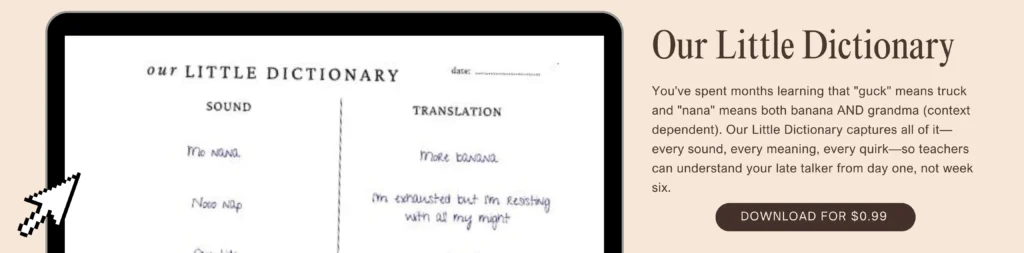
Inform the teachers right away, and create a simple family vocabulary sheet — your child’s words for common needs like “bathroom,” “water,” “hurt,” “help,” or “tired.” Share it with the staff so communication flows more smoothly and your toddler feels understood even when words are hard.
Stay calm at drop-off
If you’re anxious, hesitant, or teary, they absorb that uncertainty. Take a deep breath before you walk in. Smile. Use a confident voice. You’re modeling that preschool is safe, even when it feels hard.
Tuck in small comforts
Draw a heart or smiley face on a small card and slip it into their lunchbox with a note: “I’m thinking of you!” Tape a tiny family photo inside their cubby or backpack pocket. These tangible reminders become something they can touch when they miss home.
Create a strong reunion ritual
Make picking up just as special as dropping off. Maybe it’s a secret phrase only you two know, a special three-squeeze hug, or a silly dance you do in the parking lot. Reunion rituals reinforce the promise: you always come back.
Ask about communication options
Some preschools allow parents to call during the day if needed, or let children call home during a meltdown. Ask what’s possible. Knowing you can connect if necessary often means you won’t need to — but the safety net matters.
Allow decompression time after pickup
Don’t bombard your child with questions the second they’re in the car. Some kids need 20 or more minutes (or even a few hours) of silence, a snack, or just sitting close before they’re ready to talk. Let them lead. Quiet is okay. Processing takes time.
For introverted or quieter children: Teach the circle of support
Help your child identify who they can ask for help and how: “If you need something, you can go to Miss Sarah or Miss Elena. You can say, ‘I need help, please.'” Practice these phrases at home through role-play. If it helps, print a simple visual circle showing the trusted adults (teachers, aides, the director) and let your child keep it in their cubby or backpack. Knowing who to turn to reduces the fear of being alone in a problem.
What are the most common challenges during the toddler to preschool transition and how can I proactively address them?
Transition periods aren’t hard because your child is being difficult or because you’re doing something wrong. They’ can be challenging because of how young brains are wired and what development actually looks like in real time.
| What’s Happening in Your Child’s Brain/Body | Why It’s challenging | How to Support Them |
| Separation activates the attachment system | Your child is biologically programmed to stay close to you for safety. When you leave, their nervous system sounds an alarm. | Practice short separations beforehand. Use a consistent goodbye ritual. Reassure them: “I always come back.” |
| Self-regulation center is immature | Toddlers can’t yet manage big emotions on their own. The part of the brain that says “calm down, you’re okay” is still under construction. | Offer co-regulation: stay calm yourself, name their feelings, provide comfort. |
| New sensory and social demands feel overwhelming | Preschool is louder, brighter, busier, and more unpredictable than home. Every sound, smell, and interaction requires processing. | Prepare them with visits beforehand. Describe what they’ll see, hear, and experience. Allow decompression time after pickup. |
| Familiar routines disappear | The predictable rhythm of home — when meals happen, who helps with the potty, how naptime feels — suddenly changes. | Build consistent routines at home (morning, bedtime). Use visual schedules. Practice preschool routines (circle time, cleanup) through play. |
When to seek extra support
Most children adjust to preschool within two to four weeks. Tears at drop-off, clinginess at home, and emotional ups and downs are all normal parts of the process. But sometimes, a child needs more support than parents and teachers can provide on their own.
Consider reaching out to your pediatrician, a child psychologist, or an early childhood specialist if you notice:
- Distress lasting beyond four weeks: If your child is still inconsolable at drop-off after a month, or if the anxiety isn’t decreasing at all, something deeper might be at play.
- Severe physical symptoms: Watch for ongoing stomachaches, headaches, or vomiting that happen primarily on preschool mornings. If your little one is physically sick from anxiety — not just nervous butterflies, but actual illness — their body is signaling overwhelm that needs attention.
- Persistent sleep disruption: Nightmares, bedwetting (if previously dry), extreme difficulty falling asleep, or waking multiple times through the night that continues week after week can indicate that your child’s nervous system is stuck in high alert. Sleep issues during the first week or two are expected; ongoing sleep problems are worth addressing.
- Extreme withdrawal: If your toddler stops talking, won’t engage with family members, loses interest in favorite activities, or seems emotionally shut down — not just tired, but genuinely unreachable — this withdrawal may be a sign they’re struggling beyond typical adjustment stress.
Trust your instincts. You know your child better than anyone. If something feels off, or if you’re feeling overwhelmed yourself, reaching out for guidance isn’t a sign of failure — it’s a sign of good parenting.
The preschool search has more moving parts than most parents expect. Here’s how to navigate it: How to Find a Best Preschool for Your Child: The First Big Decision
Final thoughts
The toddler to preschool transition is big. It asks your child to step into a wider world, and it asks you to trust that world to care for them while you’re not there. That’s not small — for either of you.
But here’s what matters most: you don’t have to get it perfect. You just have to be present, prepared, and patient with the process.
FAQ
What daily routines should I start now to make my toddler’s transition to preschool smoother?
Start practicing these routines at least two weeks before preschool begins:
- Morning dressing – Let your child practice putting on clothes and shoes independently, even if it’s slow or imperfect
- Tooth brushing – Make it part of the morning routine, not just bedtime
- Packing a bag – Let your toddler help pack their backpack the night before
- Consistent bedtime – Establish a calming routine and gradually shift bedtime earlier if needed for early wake-ups
- Asking for help – Practice phrases like “I need help, please” or “Can you help me?” during everyday moments at home
How can I reduce separation anxiety for my toddler when transitioning to preschool?
Separation anxiety is biologically normal, but these strategies can ease the transition:
- Visual countdowns – Create a 7- or 14-day chart with symbols (like a school bus) and cross off one each evening. Discuss what will change (new routines, new friends) and what won’t (your love, coming back to pick them up)
- Goodbye rituals – Establish a special phrase and action that belongs only to you two, like one kiss and “See you soon, my love.” Keep it short and consistent
- Practice separations – Start with brief time apart (15-20 minutes with a trusted adult), then gradually increase. Play hide-and-seek to teach that gone doesn’t mean forever
- Calm emotional co-regulation – Your child reads your emotional state. Stay steady at drop-off, name their feelings (“You feel sad because this is new”), and reassure them calmly
- Transition object – Let them bring a small comfort item like a stuffed animal, family photo, or a card you’ve drawn on that they can keep in their cubby or backpack
What products or tools can help my toddler feel more secure and confident during the transition to preschool?
You don’t need expensive products — simple, meaningful tools work best:
- Visual countdown charts – A homemade chart with 7 or 14 boxes and symbols (school bus, backpack) helps toddlers understand when preschool starts. Cross off one each evening together. We did the design work so you don’t have to. Find it in our Ko-fi shop.
- Transition objects – A small stuffed animal, favorite blanket, or special toy your child can keep in their cubby or backpack. These familiar items provide comfort in an unfamiliar place
- Family photos – Print a small photo they can keep in their pocket, lunchbox, or taped inside their cubby. A tangible reminder that you’re thinking of them
- Routine charts – Visual step-by-step charts for morning routines (get dressed, brush teeth, pack bag) and preschool activities (circle time, snack, playground). Pictures help toddlers know what comes next
The most powerful “tool” is predictability. When your child knows what to expect and has something familiar to hold onto, the unfamiliar becomes manageable.