
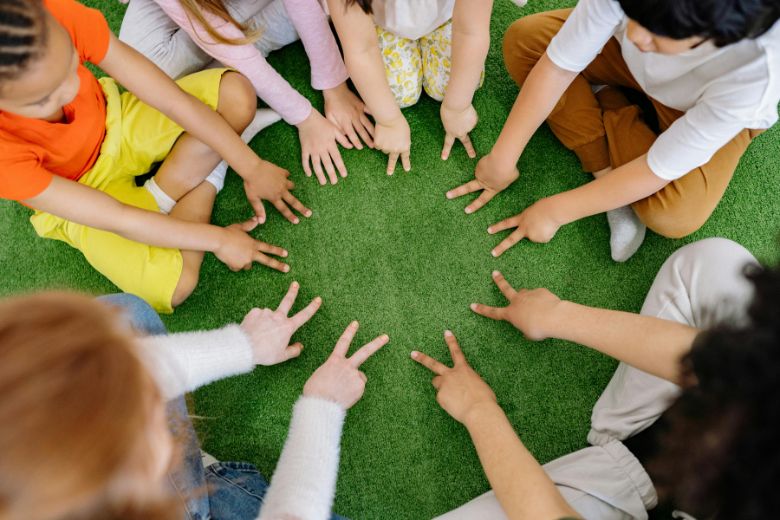
Working together with others teaches young children important social skills like teamwork, talking with friends, and solving problems. Through simple but fun group activities, kindergarten kids learn how to listen to each other, take turns, and work as a team to reach the same goal.
In this article, you will learn why working together is such an important skill for kindergarten kids. You will also discover easy ideas to help children build teamwork, listening, and problem-solving skills.
Key takeaways
- Working together builds skills for life. Teamwork, problem-solving, and talking with others are taught through fun games that are right for each age group.
- Indoor and outdoor games both help. Kids stay interested when they can choose from puzzles and LEGO building to treasure hunts and relay races.
- Working together helps kids learn about feelings. These activities teach children how to solve disagreements, care about others, and get along well with friends.
| Activity Name | Setting | Group Size | Key Skill |
| Age-appropriate puzzles | Indoor | 2–4 | Patience, teamwork |
| Simon Says / Red Light, Green Light | Indoor | Whole class | Listening, self-control |
| Building projects | Indoor | 2–4 | Creativity, cooperation |
| Musical Chairs / Freeze Dance | Indoor | Whole class | Adaptability, fairness |
| Partner art projects | Indoor | 2 | Compromise, sharing |
| “Pass the Ball” listening game | Indoor | 5–10 | Turn-taking, attention |
| Circle time group talks | Indoor | Whole class | Communication, respect |
| Building blocks together | Indoor | 3–6 | Planning, negotiation |
| Sharing games with toys | Indoor | 4–8 | Fairness, turn-taking |
| Relay races | Outdoor | Teams of 4–6 | Coordination, trust |
| Human Knot | Outdoor | 6–10 | Problem-solving, communication |
| Group obstacle course | Outdoor | 4–8 | Leadership, encouragement |
| Cooperative tug-of-war | Outdoor | Whole class | Strategy, collective effort |
| Nature scavenger hunt | Outdoor | 3–5 | Observation, shared goals |
| Clap the rhythm together | Indoor | Whole class | Listening, imitation |
| Group story building | Indoor | 4–10 | Listening, creativity |
| Paper and one pencil | Indoor | 2 | Fairness, patience |
| Mirroring | Indoor | 2 | Attentiveness, trust |
| Line up by… | Indoor | Whole class | Non-verbal communication |
Why teaching teamwork is important in kindergarten
Introducing teamwork at this age helps them build skills that will support them both in the classroom and beyond. Kindergarten is often the first place where children learn to work with others every day.
When children play and learn together, they begin to make friends, solve disagreements calmly, and understand how to cooperate with their classmates. These everyday experiences strengthen social-emotional skills like empathy, self-control, communication, and kindness.
Simple, engaging activities such as passing hula hoops, relay races, and team problem-solving games also support fine motor development, critical thinking, and social confidence. Just as importantly, they help children feel connected to their classmates and part of a shared community.
Even everyday classroom activities like building with blocks or completing puzzles together encourage patience, cooperation, and respect for different ideas. The teamwork skills children develop in kindergarten become a strong foundation for future learning, healthy friendships, and positive relationships throughout their lives.
9 indoor cooperation activities for kindergarten
Not every cooperative play activity requires outdoor space—many can be done inside the classroom or at home. Indoor games help children practice listening, following directions, and working with peers in a safe and structured environment.
Not every cooperative activity needs a playground or outdoor space. Many of the best teamwork games can happen right in the classroom or at home, giving children plenty of opportunities to practise listening, taking turns, solving problems together, and supporting one another in a calm, structured environment.
Activity #1: Age-appropriate puzzles
Working on a large floor or table puzzle in small groups encourages children to divide tasks naturally. Some sort edge pieces, others search for matching colours, while others focus on fitting sections together. With no single “right” way to organise the work, children learn to communicate, share ideas, and adjust their approach as they go.
Puzzles can be especially helpful for quieter children who may find energetic group games overwhelming but enjoy visual problem-solving and collaborative thinking.
Developmental note: Completing a shared puzzle shows children that working together often reaches a goal faster than working alone, making the value of cooperation easy to experience firsthand.
Activity #2: Simon Says and Red Light, Green Light
These classic listening games encourage children to pay close attention to shared instructions and respond together. They quickly discover that successful group participation depends on everyone listening carefully and controlling their impulses.
They’re also excellent warm-up activities before larger group projects because they establish focus and shared attention without requiring complex teamwork.
Developmental note: Listening games strengthen one of the most important foundations of cooperation: the ability to pause, pay attention, and respond to a shared cue.
Here are YouTube videos explaining how to play both Simon Says and Red Light, Green Light, so you can easily bring these games into your classroom or home routine.
Activity #3: Building projects
Using LEGO, magnetic tiles, or wooden blocks, children work together to build towers, bridges, or imaginary cities. As they combine different ideas into one shared project, they naturally practise negotiating, compromising, and making decisions as a team.
One of the biggest advantages of building projects is that the result is visible. Children can look at something they created together and celebrate their shared accomplishment.
Developmental note: Collaborative building gives children real-time practice in creative problem-solving and compromise, skills they’ll continue to use throughout school and later in life.
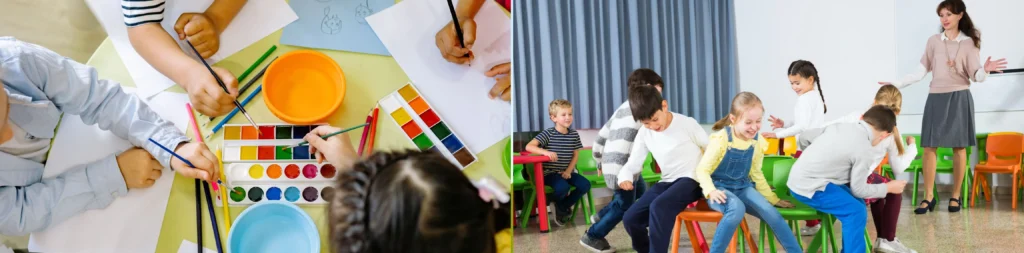
If you’d like a few simple ideas to try at home, take a look at our TikTok carousel for easy ideas that turn everyday building play into a fun opportunity to practise communication and cooperation.
Activity #4: Cooperative musical chairs and freeze dance
In cooperative versions of musical chairs, the goal shifts from competition to inclusion. Instead of eliminating players, children work together to find ways to share the remaining seats so everyone stays involved.
Freeze dance similarly builds group awareness by encouraging everyone to listen for the same musical cues and respond together. Both games make teamwork feel playful and enjoyable rather than instructional.
Developmental note: Turning competitive games into cooperative ones helps children see that games can be designed around helping others, not just winning.
Here is a YouTube video explaining how to play Freeze Dance, making it easy to add a fun, movement-based activity that builds listening skills and group awareness.
Activity #5: Partner art projects
Partner art encourages two children to create a single piece of artwork together, making shared decisions about colours, shapes, and design. Because the finished piece belongs equally to both children, listening and compromise become essential parts of the creative process.
This type of activity also supports empathy by encouraging children to appreciate someone else’s ideas and perspective alongside their own.
Developmental note: Creating something together helps children understand that collaboration often produces richer, more meaningful results than working alone.
Activity #6: Pass the ball
Children sit in a circle and pass a ball from one person to the next. Whoever holds the ball answers a question or completes a sentence before passing it on.
The physical object provides a simple visual reminder of whose turn it is, making turn-taking easy to understand while encouraging everyone else to listen respectfully.
Developmental note: Pass the ball teaches children that listening is an active contribution to the group, not simply staying quiet while someone else speaks.
Activity #7: Circle time discussions
During circle time, children gather to share ideas, answer questions, and listen to one another in a supportive environment. The consistent routine reinforces respectful communication by giving every child an opportunity to speak while others listen.
Because every child experiences both roles, speaker and listener, circle time helps build empathy and mutual respect within the classroom community.
Developmental note: Regular group discussions reinforce the idea that everyone’s voice matters and that cooperation depends on listening as much as speaking.
Want another simple way to encourage conversation and active listening? Wordless books invite children to observe, interpret, and share their own ideas, making them a wonderful tool for building communication skills. Read our article on the benefits of wordless books to discover how they can spark meaningful discussions at home or in the classroom.
Activity #8: Group building challenges
Small groups can also work on structured building tasks, such as creating the tallest freestanding tower or designing a bridge strong enough to support a book. Limited materials and a shared objective encourage children to plan together, divide responsibilities, and solve problems collaboratively.
These activities also give teachers valuable opportunities to observe classroom dynamics and gently encourage balanced participation.
Developmental note: Team building challenges demonstrate that thoughtful planning and collaboration often produce better results than individual effort.
Activity #9: Sharing games with toys
Using a limited number of popular toys or materials gives children meaningful opportunities to practise waiting, taking turns, trading fairly, and making sure everyone is included.
Because children genuinely want the items being shared, the lessons feel authentic rather than artificial, creating natural opportunities to discuss kindness and fairness.
Developmental note: Sharing games help children see fairness as an active choice, encouraging them to notice the needs of others and make thoughtful decisions that benefit the whole group.
5 outdoor cooperation activities for kindergarten
Outdoor activities naturally encourage full-body movement while helping children develop coordination, spatial awareness, communication, and trust as they solve challenges side by side.
Activity #1: Relay races
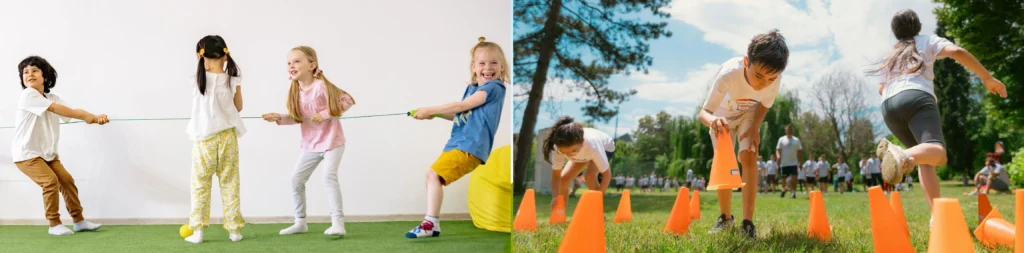
Children divide into small teams and take turns completing simple physical tasks, such as running to a cone, carrying an object, or hopping through hoops before tagging the next teammate. Every child has an important role, making each contribution essential to the team’s success.
Relay races can be especially encouraging for shy children because they provide a clear, predictable task within a supportive group setting.
Developmental note: Relay races encourage children to support one another and celebrate shared success, reinforcing teamwork instead of individual competition.
Activity #2: Human knot
In this classic group activity, children stand in a circle, reach across to hold the hands of two different people, and then work together to untangle themselves without letting go.
Because there is no designated leader and everyone plays an equal role, children must communicate, listen carefully, and solve problems together as a team.
Developmental note: The human knot promotes collective problem-solving by giving children a challenge that can only be solved through cooperation and communication.
Activity #3: Group obstacle course
Small groups work together to complete a series of outdoor challenges, such as crawling under ropes, stepping across markers, or balancing along a beam. Rather than racing individually, children encourage and assist one another throughout the course.
More confident children often naturally step into supportive roles, while others contribute through encouragement and teamwork. Activities can also be adapted to suit different ages and abilities.
Developmental note: Cooperative obstacle courses help children develop a habit of encouraging others and recognising that helping a teammate benefits the entire group.
Activity #4: Cooperative tug-of-war
Instead of competing to pull the other team across a line, this variation challenges both teams to keep the rope balanced in the centre. Children must communicate constantly and adjust their effort together to maintain equilibrium.
The unexpected twist on a familiar game creates a natural opportunity to discuss the difference between competition and cooperation.
Developmental note: Changing the objective of a familiar game helps children understand that success can be defined by working together rather than defeating others.
Activity #5: Nature scavenger hunt
Small groups receive a simple illustrated checklist of items to find outdoors, such as a round stone, something yellow, a leaf with five points, or something that makes a sound. Team members work together to search, compare observations, and complete the list before sharing their discoveries with the class.
Children quickly realise that everyone notices different details, making each person’s perspective valuable to the group’s success.
Developmental note: Nature scavenger hunts highlight the strengths that different children bring to a team and show how combining those strengths leads to better results than working alone.
Want to make your next nature walk even more engaging? We’ve shared a TikTok carousel with simple challenges to encourage children to work together, compare observations, and celebrate each other’s discoveries.
5 cooperation activities for limited-resource classrooms
Great teamwork activities don’t require expensive equipment or a large outdoor space. Many of the most effective cooperation games use little more than children’s imagination, communication, and willingness to work together. These simple activities are ideal for small classrooms, indoor recess, or settings with limited resources.
Activity #1: Clap the rhythm together
One child begins with a simple clapping pattern, such as two slow claps followed by one fast clap, and the rest of the group copies it together. The role of leader then passes to another child, who creates a new rhythm for everyone to follow.
With nothing more than their hands, children practise listening carefully, paying attention to others, and enjoying the experience of moving together as a group.
Developmental note: Shared rhythm activities strengthen listening skills, focus, and group coordination while giving every child an opportunity to lead.
Activity #2: Group story building
Children sit together and create a story one sentence at a time, with each child adding to what the previous speaker has said. Rather than changing the direction completely, children learn to accept and build on each other’s ideas as the story unfolds.
The only thing needed is a simple prompt from the teacher and plenty of imagination.
Developmental note: Collaborative storytelling encourages active listening, creativity, and respect for different perspectives while showing children how ideas can grow through cooperation.
Looking for a simple way to encourage storytelling and imagination at home? I’m The Storyteller is a wordless picture book that invites children to create their own stories from detailed illustrations, building creativity, language skills, and confidence while making every reading experience completely unique.

Activity #3: One paper, one pencil
Two children share a single sheet of paper and one pencil to create a drawing together, taking turns as they work. Because only one person can use the pencil at a time, patience and turn-taking become natural parts of the activity rather than abstract rules.
It’s an easy exercise for transition periods and often leads to valuable conversations about fairness and sharing.
Developmental note: Sharing limited materials gives children practical experience with patience, cooperation, and making decisions together.
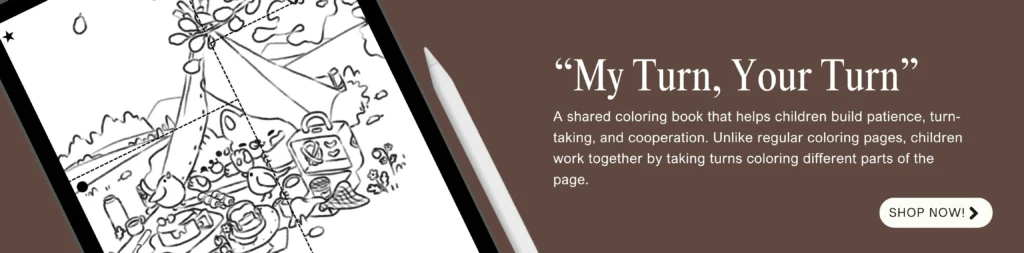
Looking for a simple way to reinforce these skills? My Turn, Your Turn is a colouring book that encourages patience, sharing, and cooperation through fun activities children can complete together.
Activity #4: Mirroring
Children work in pairs and face one another. One child slowly makes simple movements, such as raising an arm, tilting their head, or stepping sideways, while their partner mirrors every movement as closely as possible. After a minute, the roles switch.
The activity requires very little space and helps children develop careful observation and non-verbal communication skills.
Developmental note: Mirroring builds focus, empathy, and trust while giving children the experience of both leading and following.
Activity #5: Line up by…
The teacher challenges the class to line up according to birthday month, shoe size, number of siblings, or another simple category without speaking. Children must rely on gestures, facial expressions, and observation to organise themselves successfully.
The activity takes only a few minutes and works almost anywhere with enough room to stand together. Afterwards, a brief discussion about the strategies children used can reinforce the value of communication and teamwork.
Developmental note: Silent line-up challenges encourage creative problem-solving and show children that effective communication extends far beyond spoken words.
2 tips for teachers and parents to encourage teamwork
Teaching teamwork works best when both teachers and families help. Here are some ways to make activities work better:
Tip #1: Use praise and encouragement
Notice and acknowledge moments when children share, listen carefully, help a classmate, or solve a problem together. Specific praise helps children understand exactly what they did well and encourages them to repeat those behaviours.
For example, you might say, “I noticed how well your team worked together to solve that problem,” or, “Everyone did a great job listening and taking turns sharing their ideas.”
Positive feedback like this reinforces the importance of cooperation and helps children feel proud of their efforts.
Tip #2: Model good teamwork
Children learn a great deal by watching the adults around them. When teachers and parents communicate respectfully, share responsibilities, and work through challenges together, they provide a powerful example of what healthy teamwork looks like in everyday life.
By seeing cooperation modelled consistently, children are more likely to adopt those same habits in their own interactions with friends, classmates, and family members.

Start small and build up slowly – Begin with short, easy activities. Then move to harder team challenges as kids get better at working together.
When home and school use the same approach, children learn that teamwork is a normal part of everyday life.
Final thoughts
Teamwork is a skill that lasts a lifetime, and it starts with fun group activities in kindergarten. When children practice in different places—classrooms, playgrounds, and at home—they learn to value working together and build social skills that will stay with them.
Updated: 16.06.2026
FAQ
What are effective ways to measure or observe growth in cooperation and social skills?
You can watch kids grow by checking on them regularly in simple ways. Look for improvements in sharing, taking turns, listening, and following directions.
Teachers can use checklists, charts, or short notes to keep track of how kids act during group activities. Parents can watch to see if children work better with brothers, sisters, or friends. They can also look for better problem-solving and talking skills.
How can I encourage families to reinforce cooperation skills at home?
Help families join in by sharing simple teamwork games and activities they can do together at home. Families can try building with blocks, cooking easy recipes, or working as a team to complete household jobs.
Give parents ideas on how to show good teamwork themselves, praise kids when they work well together, and add short daily activities that need taking turns or working together. You can also visit our ko-fi shop for activity sheets designed to support these skills in a fun, practical way.
What should I do if conflicts arise during cooperative activities?
Conflicts are normal chances for kids to learn. When children disagree, step in to help them solve problems calmly. Encourage kids to use words to share their feelings, talk things through, and find solutions that work for everyone.
Ask questions that help them think, like “How can we work together to solve this?” or “What could we do differently next time?” Praise good behaviors and focus on teamwork rather than who wins.
Which activities are easiest to try at home with limited space or materials?
Many teamwork games need very few supplies, such as: “Pass the Ball” listening game, partner or group drawing and art projects, indoor relay races using pillows or cups, simple board games or puzzles that help kids practice taking turns.
Are these activities suitable for all kindergarteners, or should I modify them for younger or older children?
Most activities can be changed by adjusting how hard they are, how many kids play, or what the rules are. Younger children may need smaller groups, easier rules, or more help from adults. Older children can handle harder tasks, longer games, or activities that need more thinking and planning. The important thing is to match the activity to what kids can do at their age while keeping it fun and interesting.
How can these activities be integrated into existing kindergarten curricula or daily schedules?
Teamwork activities can be added to circle time, moving between activities, recess, or learning centers. Short teamwork games (5–10 minutes) can get the class ready to learn, while longer projects (like making group art or finishing a puzzle) can fit into bigger learning projects.Teachers can also combine activities with school subjects like math or reading. This way, kids practice teamwork while also learning what they need to know for class..